Adsterra Horizonal Banner

Friday, August 28, 2026

Consumer Sentiment Weakens in August 2026 According to UofM Index of Consumer Sentiment

 Consumer sentiment took a notable step backward in August 2026, according to the University of Michigan’s Index of Consumer Sentiment. The index fell 6.3% from July and was more than 11% below its level in August 2025, suggesting that consumers are becoming increasingly cautious about the economy.

That decline could eventually affect consumer spending, which is an important driver of business sales and overall economic growth. When consumers begin to feel a financial pinch, they may reduce discretionary spending, creating additional pressure on businesses.

The latest numbers highlight the mixed nature of the economy. While some economic indicators continue to point toward stability and modest growth, it remains unclear where that growth is coming from and how sustainable it will be. At the same time, declining consumer confidence suggests that the average consumer—and potentially the average worker—may be feeling more economic pressure than broader economic measures indicate.

Consumer Sentiment Weakens Sharply in August 2026

  • The University of Michigan’s Index of Consumer Sentiment fell to 51.7 in August 2026, down 6.3% from July and 11.2% below August 2025.
  • The Current Economic Conditions Index declined 5.3% from July to 51.9, suggesting consumers became less positive about current economic conditions.
  • The Index of Consumer Expectations dropped 7.0% to 51.5, indicating growing concerns about future economic conditions.
  • Inflation remains a major concern. One-year inflation expectations decreased slightly from 4.2% to 4.0%, but remained considerably above the 3.4% level recorded before the Iran conflict. Long-run inflation expectations remained at 3.3%.
  • Consumers are increasingly concerned about the broader economy, with expected business conditions declining significantly for both the one-year and five-year outlooks. Older, lower- and middle-income consumers, and those without stock holdings experienced particularly large declines in sentiment.

University of Michigan, Institute for Social Research. (2026, August 28). Surveys of consumers: Final results for August 2026. University of Michigan. https://www.sca.isr.umich.edu/

Thursday, August 27, 2026

July 2026 Wider Trade Deficit and Rising Inventories-A Few Things to Avoid

 The trade deficit widened in July 2026, which is something we would like to avoid. Exports declined while imports increased, meaning Americans are purchasing more foreign-produced goods. Ideally, we want to produce more high-value products here in the United States and compete effectively in global markets.

Of course, that depends on the types of products we are trying to compete with. Many countries can produce certain goods at a lower cost. However, when we leverage technology, develop strong human capital, and build industry clusters (innovative environments), we might have greater opportunities to increase exports (In theory). It is not a one-to-one relationship, though. A lot of factors have to align to produce goods and services that are in demand in other countries.

Like most countries, we have areas where we perform well and areas where we need improvement. Ideally, we would like to see this trend reverse so that we are creating more value domestically and selling more products overseas. That is one reason it is important for companies to continue manufacturing in the United States rather than moving production overseas simply because it may provide a slightly higher short-term profit.

Developing domestic markets (small, medium and large businesses, and improving the overall economic environment can strengthen competitiveness and create a better context for long-term economic growth.

*This blog is about exploring concepts so opinions can be the same, counter, change, etc....its all ok. We are learning. 

Advance Economic Indicators: July 2026 Shows a Wider Trade Deficit and Rising Inventories

  • The U.S. international trade deficit in goods increased to $118.8 billion in July 2026, up $17.4 billion from $101.4 billion in June.
  • July exports declined by $6.0 billion to $199.4 billion, while imports increased by $11.4 billion to $318.2 billion.
  • Wholesale inventories increased 1.3% in July to approximately $959.1 billion and were 5.7% higher than a year earlier.
  • Retail inventories increased 0.7% in July to approximately $838.5 billion and were 3.8% higher than July 2025.
  • Overall, the report provides an early look at trade and inventory conditions. Rising inventories may indicate that businesses are preparing for continued demand, although the larger trade deficit reflects stronger imports relative to exports.

U.S. Census Bureau. (2026, August 27). Advance economic indicators report: July 2026. U.S. Department of Commerce. https://www.census.gov/econ/indicators/current/index.html

Unemployment Claims Ending August 22nd, 2026 Declined Indicating Stability in the Labor Market

 The week ending August 22, 2026, looked pretty good, so that is a positive sign. The labor market appears relatively stable, and that is something we like to see. Of course, we want to see as many people working as possible. However, job numbers should always be taken with a grain of salt because they do not necessarily capture people who have dropped out of the labor market or other factors that can affect the numbers. Still, on the surface, this looks pretty good. It would be helpful to know more about what is happening beneath the surface, but based on this report, this is not bad news. A recent rise in disposable income also complements this report.

Unemployment Claims Show a Generally Stable Labor Market

  • Initial unemployment claims fell by 4,000 to 203,000 for the week ending August 22, down from the revised 207,000 reported the previous week.
  • The four-week moving average increased slightly to 205,500, suggesting that while weekly claims declined, the broader trend remains relatively stable.
  • Insured unemployment declined by 18,000 to 1.778 million, while the insured unemployment rate remained unchanged at 1.2%.
  • Compared with the same period in 2025, initial claims and insured unemployment remain lower, indicating fewer workers are receiving unemployment benefits than a year ago.
  • Overall, the report suggests a relatively stable labor market. Initial claims are considered a leading indicator of labor-market conditions, while continued claims provide confirmation of broader economic trends.

U.S. Department of Labor, Employment and Training Administration. (2026, August 27). Unemployment insurance weekly claims. U.S. Department of Labor. https://www.dol.gov/ui/data.pdf

The Value of Art: A Fiew Pieces to Ponder (Photography and Painting)

Painting example
Art is a nice little hobby that gets you away from your desk or computer on a regular basis. Sometimes I even sell a few pieces. I recently sold two: I already gave one to the buyer, who had purchased one from me before, and someone else had already asked for dibs on the other.

More importantly, art gives you an opportunity to slow down and create new connections in your brain. It is relaxing, but it also creates space for reflection. When you're painting, observing, or simply thinking about the simple things in life, you may find yourself mulling over an idea or problem. Then, suddenly, the answer comes to you.

Our brains process an enormous amount of information throughout the day. When we finally slow down, we give ourselves an opportunity to reflect, make connections, and develop solutions. Art also teaches us to see things from different perspectives—to notice something in a way we may not have seen it before. That ability to look at the world differently can open new pathways for creativity and innovation.

Photography example
We should also appreciate history and art because they are deeply connected to what makes us human. Across thousands of years, art has preserved stories, experiences, emotions, and ways of life from one generation to the next. We can accumulate all the technology we want, but these deeply human experiences have carried us from our earliest ancestors to the present.

Art, then, is not simply a frivolous or extra but a part of who we are as a species.

Check out my Gallery below. There is a $10 discount ($70 vs $80) or buying from me direct. Free shipping. I try and give a little to charity with each purchase. If there is something specific you need then send me a message to the right or use muradabel@gmail.com 

Art Gallery (Painting and Photos)

$70 Purchase Painting Pay Pal

$60 for photos (Rights to Use or Printing)

Art Gallery eBay (Paintings)

Wednesday, August 26, 2026

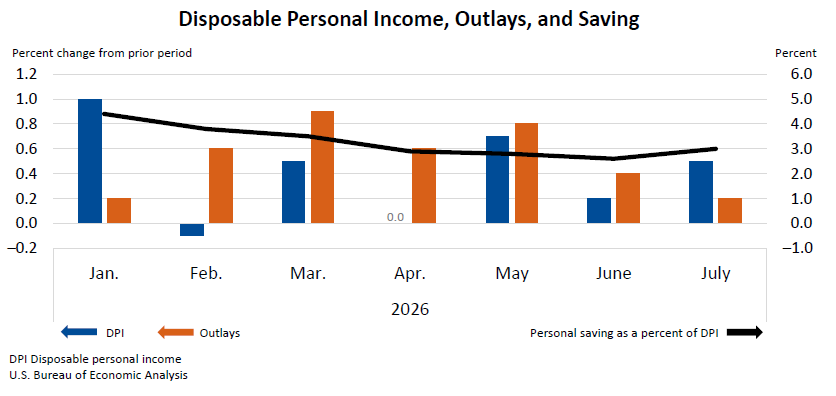
Personal Income and Consumer Spending Rise in July 2026-More Spending on Services and Less on Goods

Personal income and consumer spending both increased, which are positive signs following the decline in the prior month. However, the increases were relatively modest. Disposable income also rose slightly, while the personal savings rate remained relatively low. This suggests that although people are earning and spending a little more, they may not be setting aside much of that additional income. n

Some of the services where they are spending their money may be expenses out of the consumers control while goods has some flexibility if you can't afford it right now. Maybe, maybe not. 

Personal Income and Consumer Spending Continue to Rise in July 2026
  1. Personal income increased $115.1 billion, or 0.4%, in July, while disposable personal income rose $125.9 billion, or 0.5%.
    Source 
  2. Consumer spending increased $36.3 billion, or 0.2%, indicating that households continued to contribute to economic activity despite relatively modest overall growth.
  3. The increase in spending was concentrated in services, which rose $86.2 billion, while spending on goods declined $49.9 billion. Real consumer spending increased less than 0.1%.
  4. Inflation remained relatively moderate in July, with the PCE price index increasing 0.2%. Core PCE inflation, excluding food and energy, also increased 0.2%.
  5. Personal saving totaled $712 billion, but the personal saving rate was only 3.0% of disposable income. Overall, the report suggests that income and consumer demand remain positive, although the limited growth in real consumption and low saving rate could indicate some pressure on household finances.

U.S. Bureau of Economic Analysis. (2026, August 26). Personal income and outlays, July 2026. https://www.bea.gov/news/2026/personal-income-and-outlays-july-2026

GDP in 2nd Quarter Slows as Corporate Profits and Consumer Demand Remain Strong

The latest GDP report presents an interesting picture of the U.S. economy. Economic growth slowed to about 1.5%, roughly in line with expectations but lower than the prior period, yet consumer demand remains strong and corporate profits continue to rise.

The combination raises an important question: Are businesses becoming more efficient through technology and productivity improvements? If so, that efficiency could strengthen companies while creating challenges for workers who may struggle to adapt to changing job requirements (i.e. flexible training and education). 

Over the long term, there is also a concern that corporate profits and productivity could rise while wages and the economic value of the average worker fail to keep pace. These will be the gist of some questions as we see how a recent mass influx of technology will make their way into adaptation.We do continue to discuss human capital on this blog because it will likely (proabable) become increasingly economically important for sustained growth.

It is also ok to have a different economic opinion as I might change mine tomorrow. In general I think human capital will become more important. Maybe, maybe not.

U.S. GDP Growth Slows to 1.5% in Second Quarter of 2026

  • Real GDP increased at an annual rate of 1.5% in the second quarter of 2026, unchanged from the advance estimate but down from 2.1% growth in the first quarter.
  • Consumer spending, exports, and investment supported economic growth, while declining government spending partially offset those gains.
  • Real final sales to private domestic purchasers increased 4.2%, suggesting relatively strong underlying private-sector demand despite slower overall GDP growth.
  • Inflation remained elevated, with the PCE price index rising 5.3% and core PCE, excluding food and energy, increasing 3.6%.
  • Corporate profits from current production increased by $400.9 billion in the second quarter, a substantial acceleration from the $74.4 billion increase in the first quarter.

U.S. Bureau of Economic Analysis. (2026, August 26). GDP (second estimate) and corporate profits, 2nd quarter 2026. https://www.bea.gov/news/2026/gdp-second-estimate-and-corporate-profits-2nd-quarter-2026

Enhancing Stronger Systems: Corruption, Judicial Perceptions, and Public Trust

In business economics, the justice system plays an important role in maintaining a healthy society, protecting rights, and upholding the values that support economic activity. Our hypothetical Allegory of the Clan illustrates how hate, corruption, and victim-blaming can work together to undermine social contracts, weaken trust, and create human capital problems.

A strong, functioning judicial system is important not only to society but also to everyday business. Contracts and business relationships depend on the expectation that all parties will be treated fairly and that there will be consequences when agreements or rights are violated. When people trust institutions to do the right thing, there is an economic advantage because trust encourages participation, investment, cooperation, and long-term relationships.

Conversely, when corruption or misconduct goes uncorrected, it can undermine confidence in the entire system. Ideally, there should be effective mechanisms for holding corrupt individuals accountable and removing them from positions of authority. In practice, however, this can be difficult when institutional protections and layers of immunity shield poor or intentionally harmful behavior. That becomes especially troubling when problems are well known and have created long-term patterns. 

These challenges demonstrate why accountability and institutional integrity matter to both society and the economy. When people believe the system is fair and capable of correcting wrongdoing, they are more likely to participate in it and trust its institutions. When that confidence disappears, the resulting costs can extend well beyond the immediate victims and create broader social and economic problems.

Corruption, Judicial Legitimacy, and Public Trust

  • The study examines how people evaluate courts when corruption cases involving powerful business leaders raise questions about both judicial outcomes and procedural fairness.
  • Using a survey experiment with 1,042 respondents in Brazil, the researcher manipulated both judicial misconduct and whether a corruption conviction was upheld or overturned.
  • The findings indicate that outcomes mattered more than procedural irregularities: respondents were substantially less supportive of courts when corruption convictions against business leaders were overturned.
  • Procedural fairness still influenced perceptions of individual judges, particularly when judges appeared self-interested, biased, or improperly involved with prosecutors.
  • Overall, the research suggests that public legitimacy may depend heavily on whether courts are perceived as holding powerful economic actors accountable, demonstrating the tension between due process and substantive justice.

Vilaça, L. (2026). Corruption and the legitimacy of courts: Experimental evidence from Brazil. Social Forces. https://doi.org/10.1093/sf/soag029