Adsterra Horizonal Banner

Sunday, May 17, 2026

Gallop Leadership and Management Indicators: How to Develop Trust, Engagement and Performance

Trust is critically important within organizations, yet research continues to show that trust between employees, managers, and leadership is often lower than it should be. Organizations are ultimately collections of people, and individuals join them not only for compensation, but because they bring valuable skills, knowledge, and abilities to the workplace.

People remain with organizations for many reasons beyond pay. Strong managers play a major role in retaining employees by keeping them engaged in meaningful work, setting goals, creating a sense of community, and helping employees grow and develop professionally. When people feel connected to their work and believe they are contributing to something important, it strengthens both individual motivation and organizational performance.

While return on investment and shareholder value are important, organizations must also recognize the human side of work. Employees are often willing to contribute significant effort when they feel they are part of a supportive team, have purpose in their role, and know their work matters.

Problems emerge when leadership treats employees as replaceable machinery rather than people. If employees believe management does not support them, invest in their development, or care about their long-term success, organizations are likely to experience poor retention, declining morale, and the loss of valuable human capital.

Successful organizations build strong connections with employees and help them find pathways to achieve personal and professional goals within the company. Treating employees with respect and showing that they are valued can create deep loyalty. In many cases, people will remain with an organization for 20 or 30 years because they genuinely enjoy where they work, even when higher-paying opportunities may exist elsewhere. 

If you need a little help or guidance, I offer hobby coaching on a casual basis and you can reach out via the email provided or the contact option to the right to set up a virtual session. I typically charge around $50 per session and treat this as a side hobby, and I donate about 50% of what I earn to charity while the remainder goes toward expenses or personal use. Sometimes having an outside perspective can make a big difference in getting focused and moving in the right direction, and even simple feedback on your ideas can be valuable. If you're interested, feel free to get in touch and we can set something up. muradabel@gmail.com

Gallup Leadership and Management Indicators: Employee Trust, Engagement, and Organizational Performance

  • Gallup measures employee perceptions of leadership, management quality, and performance management practices within organizations.
  • Only 19% of employees strongly agreed that they trust their organization’s leadership, reflecting ongoing challenges in workplace confidence and communication.
  • Gallup emphasizes that managers account for approximately 70% of the variance in team engagement, making management quality a major driver of organizational success.
  • Strong leadership contributes to higher employee engagement, improved profitability, reduced turnover, and lower burnout levels.
  • Modern managers face increasing pressure due to hybrid work, employee disengagement, turnover, and organizational instability in the post-pandemic workplace.
  • Gallup advocates shifting from traditional annual performance reviews toward continuous coaching, strengths development, goal setting, and frequent feedback.
  • Employees who receive regular feedback and participate in goal setting are significantly more likely to feel engaged at work.
  • Gallup research identifies leadership competencies such as relationship building, communication, accountability, critical thinking, and employee development as essential for effective management.
  • Research also highlights leadership blind spots, where managers often rate their own effectiveness more positively than employees do.
  • Gallup’s findings suggest that investing in leadership development and manager support can improve organizational culture, employee wellbeing, and long-term business performance.

Gallup. (n.d.). Global indicator: Leadership & management. Gallup. https://www.gallup.com/404252/indicator-leadership-management.aspx

Subscribe to the Feed

Three Must Dos In Fitness

Rowing at a club.


There are three primary ways to improve your health and get into better shape, and it’s often best to approach them in this order.

First, set a realistic goal. Whether you want to lose 5 pounds or 10 pounds, understand that healthy progress takes time. Rapid weight loss is often regained quickly once routines change, and it usually isn’t sustainable long term. A reasonable target for many people is about one pound per week, which can often be achieved by reducing daily calorie intake by around 500 calories. The key is giving yourself enough time to build habits that last.

Second, incorporate exercise into your routine. Having a schedule can help, but consistency matters more than perfection. Exercise doesn’t always mean going to the gym. You can improve your health by biking around your neighborhood, walking on the beach, hiking, or staying active throughout the day. If your goal is to gain muscle and strength, you’ll need some form of resistance training, but even resistance bands and bodyweight exercises can make a noticeable difference. If flexibility and balance are your focus, activities like yoga, Pilates, and dance are excellent options. Understanding your goals will help determine the type and amount of exercise that works best for you.

Third, focus on nutrition. For many people, nutrition plays the largest role in long-term health. Study after study shows that eating habits heavily influence overall wellness and longevity, even for people who do not exercise regularly. That said, building strength and muscle mass still provides major health benefits. In general, it’s best to increase lean protein intake, eat more vegetables and whole foods, and reduce heavily processed carbohydrates. However, carbs are still important, especially complex carbohydrates, because your body and brain rely on them for energy. Extremely restrictive or zero-carb diets are often difficult to maintain and may not be the healthiest long-term solution.

I hold certifications as both a fitness trainer and yoga instructor. If you’d like guidance with setting goals, creating a workout routine, or building a sustainable nutrition plan, feel free to send me a message to the right or use the email below. I offer virtual sessions designed to help people get started, stay accountable, and create a plan that fits their lifestyle. muradabel@gmail.com

I also try to donate about 50% of what I earn to various charities, while the other 50% helps support healthy meals and continued training resources.

There’s no better time to start than today. Even a few sessions can help you get organized, build momentum, and move in the right direction.

Subscribe to the Feed

Saturday, May 16, 2026

The Architecture of Animus: Neurological Realities and the Allegory of the Clan

(Illustrative only)

Representing hate in the brain, the theory of the mirror, 
and how to understand to create
invisibility in society.


Hate has long been a destructive force in society, contributing to division, conflict, and instability within communities and society at large. It often emerges and spreads because it can be leveraged—whether to gain resources, strengthen group identity, or mobilize support. In this sense, it can resemble older tribal dynamics, where cohesion within a group depended on distinguishing and opposing outsiders, and at times even internal members who are redefined as outsiders because they think for themselves.

As societies become more complex and developed, these patterns persist in more subtle forms. Fear and insecurity can lead people to project distorted beliefs onto others, sometimes resulting in hostility, misinformation, or coordinated social exclusion. These patterns are not formed overnight but tend to develop over time through repeated reinforcement within specific social environments.

At its core, hate is often rooted in fear or perceived threat. It reflects something unresolved within the individual or group expressing it. Those who are targeted by hate, however, often experience only the outward aggression—rumors, hostility, or exclusion—which naturally provokes defensive responses and conflict in return. In some cases, people may learn to respond more strategically rather than reacting immediately, but the pressure of sustained hostility toward victims still shapes outcomes. In corrupt systems that embrace hate the victims are almost always seen as at fault. i.e Tulsa massacre that no one corrected. Open displays intentional officialized dehumanization.

This dynamic can become self-reinforcing. Hate attempts to provoke harm and reaction, and those reactions can then be used as further justification for continued hostility. Even silence or non-response may be interpreted as validation. Notice a pattern in blame. Basically, there is nothing the victims can do except be good victims or challenge the roots that cause the hate. Over time, this can escalate to the point where targeted individuals or groups are viewed as undeserving of basic rights or participation in society. It happens in history and continues to happen.

In this “Allegory of the Clan,” such judgments can persist regardless of historical ties, including generations of residence back to the start, genrations of sacrafice-service, or even foundational contributions to a nation’s initial development. In these cases, the target is stripped of perceived legitimacy, and history or contribution is disregarded. In our learning story the courts stripped the victims of dignity, allowed behaviors against others, failed to remove the incentives and undermined our social contracts to help clan members (in theory). The risks of rising nationalism (identity) versus patriotism (principle) become apparent. Much of society is at risk when such behaviors are normalized.

Recognizing this pattern does not mean ignoring harm or dismissing accountability. The goal is not to get people in trouble. It means understanding that hate often reflects the beliefs and fears of those who express it more than the reality of those who are targeted. No person or official is immune from the aphorodesiac of hate. From that perspective, responses can be grounded in clarity and restraint rather than escalation.

A constructive response requires both boundaries and responsibility. While individuals and communities must protect themselves from harm, there is also value in choosing not to mirror hostility. Understand their choices are their choices and a mirror into their soul and the soul of the decision makers that allowed it. Those who fail to correct behaviors agsinst those they liken to dogs and anomals. Forgiveness, in this sense, is not the absence of accountability, but the refusal to be consumed by the same cycle of aggression. Return hate with love and empathy. No matter what misbehaviors decision makers embrace.

At the same time, forgiveness alone is not sufficient. Harmful behavior has real consequences, and systems that allow abuse, manipulation, or exclusion to persist without correction can perpetuate harm across generations. There is a responsibility to address wrongdoing, prevent future harm, and restore fairness where it has been undermined. or not? 🤷It just depends on your personal beliefs.

Ultimately, a stable and just society depends on balancing these principles: resisting cycles of hate while still ensuring accountability for individuals and systems. Those who can restrain their reaction and move to a higher moral conscious and calling may be seen as second class citizens but are sometimes the first among men/women. One of the reasons why freedom of speech, freedom of religion, and our social contracts should be strenghthened and preserved. 

"No one is more hated than he who speaks the truth." Plato

*The Allegory of the Clan is a hypothetical, philsophical, running thought experiment on hate. You may arrange the elements and come to any conclusion you desire. 

Neural Correlates of Hate

  • The study explored how the brain responds when individuals view someone they hate compared to someone they feel neutral toward.
  • Researchers used functional MRI (fMRI) scans on participants while they viewed images of hated individuals and neutral acquaintances.
  • Several brain regions became more active during feelings of hate, including areas associated with aggression, emotional processing, and movement planning.
  • Some activated regions overlapped with areas involved in romantic love, suggesting that intense emotions may share neurological pathways.
  • Unlike love, hate also activated brain regions associated with judgment, threat assessment, and preparing for action.
  • The researchers suggested that hate is a complex emotional state involving both emotional attachment and defensive or aggressive readiness.
  • Findings contributed to understanding how strong social emotions are represented in the human brain.

Zeki, S., & Romaya, J. P. (2008). Neural correlates of hate. PLoS ONE, 3(10), e3556. https://doi.org/10.1371/journal.pone.0003556


Subscribe to the Feed

Coastal Birds in San Diego Starving from Rising Ocean Temperatures (Painting of Stork in the Air)

Stork in the Air
$100
Seabirds have been lining the coast in San Diego, and many are dying because they are unable to find enough food. When ocean temperatures rise, fish often move farther offshore into cooler waters, putting them out of reach for many coastal birds that rely on nearshore feeding areas. The report below discusses how warming ocean conditions are affecting local seabird populations along the Southern California coast. It’s an interesting article from the Times of San Diego.

The painting featured here is of a seabird that lives along the San Diego coastline. It’s probably not one of my best paintings, so I’m listing it at a lower price than some of my others. I was experimenting with a new technique that I’m not entirely sure worked the way I wanted, but I’m still putting it out there in case someone connects with it or finds it interesting.

I paint as a hobby, and I plan to continue sharing more paintings and photos over time. About half of what I make goes to charity, while the other half helps support the cost of materials and time. The paintings are shipped unframed, though framing can be added for an additional cost to cover the frame and shipping expenses.

You may check out My Gallery and Art Page muradabel@gmail.com

 Starving Seabirds Along San Diego’s Coast Highlight the Impact of Rising Ocean Temperatures

  • Large numbers of starving seabirds have been washing up along the coast of San Diego, especially from Mission Beach to La Jolla.
  • Warmer-than-normal ocean temperatures are pushing fish into deeper and cooler offshore waters.
  • Seabirds such as brown pelicans, cormorants, common murres, and seagulls are struggling to reach their food supply.
  • Rescue organizations, including SeaWorld Rescue and researchers from Scripps Institution of Oceanography, report that many rescued birds are severely emaciated and dehydrated.
  • Scientists believe ongoing marine heatwaves and warming ocean conditions are disrupting nutrient-rich upwelling systems that normally support marine ecosystems.
  • Experts warn that these seabird mortality events may become more common as ocean temperatures continue to rise.
  • Beachgoers are encouraged not to handle distressed birds and instead report them to wildlife rescue organizations.

APA Reference
Murphy, T. (2026, May 13). Starving seabirds line San Diego’s coast. Rising ocean temperatures are to blame. Times of San Diego. https://timesofsandiego.com/environment/2026/05/13/dead-seabirds-ilne-san-diegos-coast-due-to-hot-oceantemps/

Subscribe in a reader

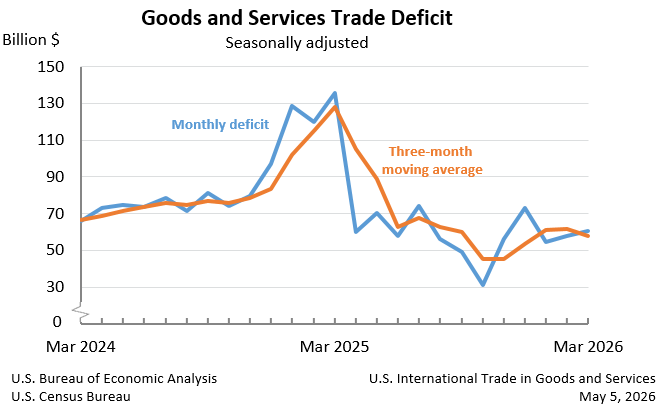
US International Trade Deficit March 2026 and the Need of Exportation

 We often talk about the economy as if it is stuck somewhere in the middle, not too hot, not too cold, but still not quite right. Looking at the March 2026 trade report, you can see why that feeling exists. Imports increased significantly, and exports also rose, showing that there is still strong economic movement and demand. The concern, however, is that imports are growing faster than exports, which widens the trade gap and highlights ongoing challenges in domestic production and manufacturing capacity.

If the United States wants to strengthen manufacturing and improve exports, part of the solution may come from supporting unique small- and medium-sized businesses that create new products, adapt existing ones, or engineer specialized solutions for global markets. Communities such as Escanaba and Gladstone could play an important role in that process by offering a combination of affordable living, growing infrastructure, skilled labor, and entrepreneurial opportunity.


When businesses operate within creative and collaborative environments, they are more likely to innovate, design new products, and develop export opportunities that reach overseas markets. Whether through advanced manufacturing, specialized engineering, or adapting products to meet changing demands, there is significant opportunity to grow exports by investing in human capital, intellectual capacity, and local economic development. 

(FYI it would be helpful if leadership focused on building economic and social development so they may enhance and create synergy for growth.)

Ultimately, improving exports is not just about large corporations or national policy. It is also about empowering regional economies, skilled workers, entrepreneurs, and innovators to turn existing resources and ideas into globally competitive products. The policies, management skill, organizational development, coordination of stakeholders,, etc. contribute to this capacity.

U.S. International Trade Deficit Increased in March 2026

  • The U.S. goods and services trade deficit increased to $60.3 billion in March 2026, up from $57.8 billion in February.
  • U.S. exports rose to $320.9 billion, increasing by $6.2 billion from February.
  • Imports increased to $381.2 billion, up $8.7 billion from the previous month.
  • The goods deficit widened by $4.1 billion to $88.7 billion, while the services surplus increased by $1.6 billion to $28.4 billion.
  • March exports of goods and services reached a record high of $320.9 billion.
  • Imports of capital goods also reached a record high at $120.7 billion.
  • Growth in imports outpaced exports, contributing to the widening trade gap.
  • Increased imports of vehicles, consumer goods, and capital goods were major contributors to the larger deficit.
  • Higher exports of crude oil, petroleum products, and agricultural goods partially offset the increase in imports.

U.S. Bureau of Economic Analysis. (2026, May 5). U.S. international trade in goods and services, March 2026. https://www.bea.gov/news/2026/us-international-trade-goods-and-services-march-2026

Subscribe to the Feed

NFPA 1700 2026 Edition Updates and Staying Knowledgeable of Changes

 Firefighting requires continuous training, updated knowledge, and a strong commitment to learning. Reviewing recent changes is valuable because research and science are regularly integrated into updated standards like the NFPA 1700 (2026 edition), which provides improved guidance for structural firefighting.

NFPA 1700 (2026): Key Updates in Structural Firefighting Guidance

  • The 2026 edition of NFPA 1700 expands research-based guidance for structural firefighting, emphasizing life safety as the highest priority in all fireground decisions.
  • A major new addition is Chapter 13, which formally addresses tactical considerations for search and rescue, including when and how to begin searches based on occupant survivability factors.
  • Updated research from UL’s Fire Safety Research Institute is incorporated, including findings on coordinated fire attack, ventilation, and fire behavior in modern building types.
  • New hazard considerations include lithium-ion battery fires and energy storage systems, which introduce risks such as thermal runaway and explosion potential.
  • Chapter updates emphasize improved fireground size-up, including 360-degree assessment, ventilation profile analysis, and identification of survivable spaces.
  • Tactical guidance in fire control has been revised to align suppression and ventilation with search priorities, reinforcing that fire attack supports primary search operations.
  • The guide clarifies offensive vs. defensive strategy selection, stressing that improper strategy choice is a key factor in firefighter line-of-duty deaths and mayday events.
  • Exterior and interior suppression techniques are updated, including clearer direction on when indirect attack methods are appropriate and how flow-and-move techniques improve survivability.
  • NFPA 1700 continues to function as a “standard of care” guide, providing science-based justification for fireground decision-making and training practices.

Madrzykowski, D., Stakes, K., Stewart, C., & others. (2026, April 15). NFPA 1700, guide for structural fire fighting: What’s new for 2026. Fire Engineering. https://www.fireengineering.com/firefighting/structural-firefighting/nfpa-1700-guide-for-structural-fire-fighting-whats-new-for-2026/

Survey of Professonal Forecasters May 2026 Indicate Some Softening of the Economy, Higher Inflation, and Possible Contraction

(Illustrative Only)

Something doesn't 
smell just right 
in the market. 


Forecasting uses past and current data to make informed predictions about future economic conditions. In the case of the U.S. economy, recent indicators suggest a generally stable but unremarkable environment—neither particularly strong nor clearly weak. Growth has been steady, but there are signs that momentum is softening.

According to the Survey of Professional Forecasters May 2026, real GDP is expected to grow around 2.2% in 2026, which reflects modest expansion but not especially strong performance. This aligns with broader signals of slowing economic momentum observed over recent quarters.

The unemployment rate is projected to remain relatively stable, suggesting limited movement in labor market conditions. In practical terms, this points to a “wait and see” job environment where significant changes in hiring or layoffs are not widely expected in the near term.

At the same time, inflation (as measured by CPI) is expected to run somewhat higher than previously forecast. That implies continued upward pressure on prices, which can affect household purchasing power, borrowing costs, and credit card debt burdens.

There are also some downside risks in the outlook, including the possibility of occasional negative GDP quarters later in the forecast horizon. While not the baseline expectation, this signals that short-term contractions cannot be ruled out.

Overall, the picture is mixed: stable employment, moderate growth, and persistent inflation pressures, combined with some uncertainty about downside risks. This environment makes careful monitoring of economic trends especially important when making financial or business decisions.

U.S. Economic Outlook Softens: Key Takeaways from the Q2 2026 Survey of Professional Forecasters

  • The Philadelphia Fed’s Survey of Professional Forecasters shows a weaker near-term U.S. growth outlook compared with the previous quarter.
  • Real GDP is expected to grow about 2.2% in 2026 (annual average), a downward revision of 0.3 percentage points from the prior survey.
  • Forecasters expect slower growth in each of the next several quarters, signaling a softening momentum in economic activity.
  • Q2 headling inflation rose to 6%.
  • The unemployment rate is projected to remain relatively stable, rising modestly from about 4.4% to 4.5% into early 2027.
  • Inflation expectations for 2026 have been revised higher, especially in the short run, with CPI inflation expected to run above prior estimates.
  • Forecasters see a higher probability of elevated inflation in 2026, including greater chances of CPI running above 3%.
  • The risk of a negative GDP quarter rises in later periods of 2026, indicating increased downside risk to growth.

Federal Reserve Bank of Philadelphia. (2026, May 15). Second quarter 2026 survey of professional forecasters. https://www.philadelphiafed.org/surveys-and-data/real-time-data-research/spf-q2-2026