Adsterra Horizonal Banner

Saturday, May 16, 2026

Coastal Birds in San Diego Starving from Rising Ocean Temperatures (Painting of Stork in the Air)

Stork in the Air
$100
Seabirds have been lining the coast in San Diego, and many are dying because they are unable to find enough food. When ocean temperatures rise, fish often move farther offshore into cooler waters, putting them out of reach for many coastal birds that rely on nearshore feeding areas. The report below discusses how warming ocean conditions are affecting local seabird populations along the Southern California coast. It’s an interesting article from the Times of San Diego.

The painting featured here is of a seabird that lives along the San Diego coastline. It’s probably not one of my best paintings, so I’m listing it at a lower price than some of my others. I was experimenting with a new technique that I’m not entirely sure worked the way I wanted, but I’m still putting it out there in case someone connects with it or finds it interesting.

I paint as a hobby, and I plan to continue sharing more paintings and photos over time. About half of what I make goes to charity, while the other half helps support the cost of materials and time. The paintings are shipped unframed, though framing can be added for an additional cost to cover the frame and shipping expenses.

You may check out My Gallery and Art Page muradabel@gmail.com

 Starving Seabirds Along San Diego’s Coast Highlight the Impact of Rising Ocean Temperatures

  • Large numbers of starving seabirds have been washing up along the coast of San Diego, especially from Mission Beach to La Jolla.
  • Warmer-than-normal ocean temperatures are pushing fish into deeper and cooler offshore waters.
  • Seabirds such as brown pelicans, cormorants, common murres, and seagulls are struggling to reach their food supply.
  • Rescue organizations, including SeaWorld Rescue and researchers from Scripps Institution of Oceanography, report that many rescued birds are severely emaciated and dehydrated.
  • Scientists believe ongoing marine heatwaves and warming ocean conditions are disrupting nutrient-rich upwelling systems that normally support marine ecosystems.
  • Experts warn that these seabird mortality events may become more common as ocean temperatures continue to rise.
  • Beachgoers are encouraged not to handle distressed birds and instead report them to wildlife rescue organizations.

APA Reference
Murphy, T. (2026, May 13). Starving seabirds line San Diego’s coast. Rising ocean temperatures are to blame. Times of San Diego. https://timesofsandiego.com/environment/2026/05/13/dead-seabirds-ilne-san-diegos-coast-due-to-hot-oceantemps/

Subscribe in a reader

US International Trade Deficit March 2026 and the Need of Exportation

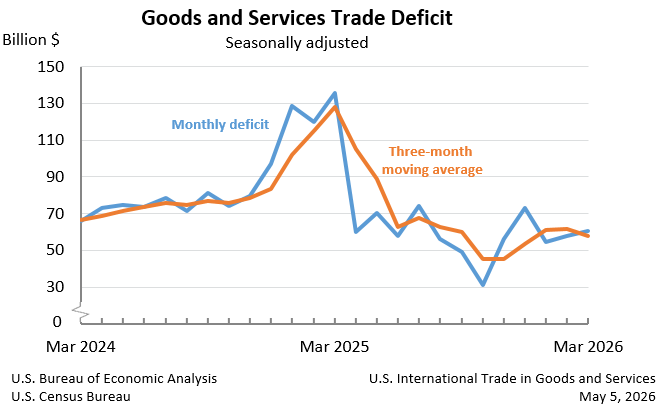
 We often talk about the economy as if it is stuck somewhere in the middle, not too hot, not too cold, but still not quite right. Looking at the March 2026 trade report, you can see why that feeling exists. Imports increased significantly, and exports also rose, showing that there is still strong economic movement and demand. The concern, however, is that imports are growing faster than exports, which widens the trade gap and highlights ongoing challenges in domestic production and manufacturing capacity.

If the United States wants to strengthen manufacturing and improve exports, part of the solution may come from supporting unique small- and medium-sized businesses that create new products, adapt existing ones, or engineer specialized solutions for global markets. Communities such as Escanaba and Gladstone could play an important role in that process by offering a combination of affordable living, growing infrastructure, skilled labor, and entrepreneurial opportunity.


When businesses operate within creative and collaborative environments, they are more likely to innovate, design new products, and develop export opportunities that reach overseas markets. Whether through advanced manufacturing, specialized engineering, or adapting products to meet changing demands, there is significant opportunity to grow exports by investing in human capital, intellectual capacity, and local economic development. 

(FYI it would be helpful if leadership focused on building economic and social development so they may enhance and create synergy for growth.)

Ultimately, improving exports is not just about large corporations or national policy. It is also about empowering regional economies, skilled workers, entrepreneurs, and innovators to turn existing resources and ideas into globally competitive products. The policies, management skill, organizational development, coordination of stakeholders,, etc. contribute to this capacity.

U.S. International Trade Deficit Increased in March 2026

  • The U.S. goods and services trade deficit increased to $60.3 billion in March 2026, up from $57.8 billion in February.
  • U.S. exports rose to $320.9 billion, increasing by $6.2 billion from February.
  • Imports increased to $381.2 billion, up $8.7 billion from the previous month.
  • The goods deficit widened by $4.1 billion to $88.7 billion, while the services surplus increased by $1.6 billion to $28.4 billion.
  • March exports of goods and services reached a record high of $320.9 billion.
  • Imports of capital goods also reached a record high at $120.7 billion.
  • Growth in imports outpaced exports, contributing to the widening trade gap.
  • Increased imports of vehicles, consumer goods, and capital goods were major contributors to the larger deficit.
  • Higher exports of crude oil, petroleum products, and agricultural goods partially offset the increase in imports.

U.S. Bureau of Economic Analysis. (2026, May 5). U.S. international trade in goods and services, March 2026. https://www.bea.gov/news/2026/us-international-trade-goods-and-services-march-2026

NFPA 1700 2026 Edition Updates and Staying Knowledgeable of Changes

 Firefighting requires continuous training, updated knowledge, and a strong commitment to learning. Reviewing recent changes is valuable because research and science are regularly integrated into updated standards like the NFPA 1700 (2026 edition), which provides improved guidance for structural firefighting.

NFPA 1700 (2026): Key Updates in Structural Firefighting Guidance

  • The 2026 edition of NFPA 1700 expands research-based guidance for structural firefighting, emphasizing life safety as the highest priority in all fireground decisions.
  • A major new addition is Chapter 13, which formally addresses tactical considerations for search and rescue, including when and how to begin searches based on occupant survivability factors.
  • Updated research from UL’s Fire Safety Research Institute is incorporated, including findings on coordinated fire attack, ventilation, and fire behavior in modern building types.
  • New hazard considerations include lithium-ion battery fires and energy storage systems, which introduce risks such as thermal runaway and explosion potential.
  • Chapter updates emphasize improved fireground size-up, including 360-degree assessment, ventilation profile analysis, and identification of survivable spaces.
  • Tactical guidance in fire control has been revised to align suppression and ventilation with search priorities, reinforcing that fire attack supports primary search operations.
  • The guide clarifies offensive vs. defensive strategy selection, stressing that improper strategy choice is a key factor in firefighter line-of-duty deaths and mayday events.
  • Exterior and interior suppression techniques are updated, including clearer direction on when indirect attack methods are appropriate and how flow-and-move techniques improve survivability.
  • NFPA 1700 continues to function as a “standard of care” guide, providing science-based justification for fireground decision-making and training practices.

Madrzykowski, D., Stakes, K., Stewart, C., & others. (2026, April 15). NFPA 1700, guide for structural fire fighting: What’s new for 2026. Fire Engineering. https://www.fireengineering.com/firefighting/structural-firefighting/nfpa-1700-guide-for-structural-fire-fighting-whats-new-for-2026/

Survey of Professonal Forecasters May 2026 Indicate Some Softening of the Economy, Higher Inflation, and Possible Contraction

(Illustrative Only)

Something doesn't 
smell just right 
in the market. 


Forecasting uses past and current data to make informed predictions about future economic conditions. In the case of the U.S. economy, recent indicators suggest a generally stable but unremarkable environment—neither particularly strong nor clearly weak. Growth has been steady, but there are signs that momentum is softening.

According to the Survey of Professional Forecasters May 2026, real GDP is expected to grow around 2.2% in 2026, which reflects modest expansion but not especially strong performance. This aligns with broader signals of slowing economic momentum observed over recent quarters.

The unemployment rate is projected to remain relatively stable, suggesting limited movement in labor market conditions. In practical terms, this points to a “wait and see” job environment where significant changes in hiring or layoffs are not widely expected in the near term.

At the same time, inflation (as measured by CPI) is expected to run somewhat higher than previously forecast. That implies continued upward pressure on prices, which can affect household purchasing power, borrowing costs, and credit card debt burdens.

There are also some downside risks in the outlook, including the possibility of occasional negative GDP quarters later in the forecast horizon. While not the baseline expectation, this signals that short-term contractions cannot be ruled out.

Overall, the picture is mixed: stable employment, moderate growth, and persistent inflation pressures, combined with some uncertainty about downside risks. This environment makes careful monitoring of economic trends especially important when making financial or business decisions.

U.S. Economic Outlook Softens: Key Takeaways from the Q2 2026 Survey of Professional Forecasters

  • The Philadelphia Fed’s Survey of Professional Forecasters shows a weaker near-term U.S. growth outlook compared with the previous quarter.
  • Real GDP is expected to grow about 2.2% in 2026 (annual average), a downward revision of 0.3 percentage points from the prior survey.
  • Forecasters expect slower growth in each of the next several quarters, signaling a softening momentum in economic activity.
  • Q2 headling inflation rose to 6%.
  • The unemployment rate is projected to remain relatively stable, rising modestly from about 4.4% to 4.5% into early 2027.
  • Inflation expectations for 2026 have been revised higher, especially in the short run, with CPI inflation expected to run above prior estimates.
  • Forecasters see a higher probability of elevated inflation in 2026, including greater chances of CPI running above 3%.
  • The risk of a negative GDP quarter rises in later periods of 2026, indicating increased downside risk to growth.

Federal Reserve Bank of Philadelphia. (2026, May 15). Second quarter 2026 survey of professional forecasters. https://www.philadelphiafed.org/surveys-and-data/real-time-data-research/spf-q2-2026

Life Afloat: Freedom, Frustration, and Fixing Things That Should Have Worked the First Time

(Illustrative Only)

Should never feed a duck
just because its cute. 
I told it not to tell 
the other ducks. The next day
the extended family 
wants to move in. 🦆😐
Living and working on a boat is one of those experiences you really can’t explain unless you’ve done it. It’s not always accessible to everyone, though hopefully it becomes more so over time. Recreational boating and sailing are about more than just owning a boat. It’s about being on the water, surrounded by nature, feeling free, and living in a way that feels a little closer to how humans were probably designed to live before someone invented HOA meetings and email chains.

Once you spend enough time on a boat — not necessarily even living aboard full-time — you start to notice changes in how you see the world. Your stress level drops. Your priorities shift. Sunsets suddenly become a major event. Wind direction becomes breaking news. You begin casually saying things like, “The tide is against us today,” as if you’re an extra in a pirate documentary.

Joy… but also chaos.

Because no matter how peaceful boating looks on Instagram, eventually something breaks.

For example, I spent an absurd amount of time installing new port and starboard navigation lights. Apparently, the previous owner believed electrical systems should resemble abstract art, so I had to trace wires, fix grounding issues, and figure out why one light worked while the other one refused to acknowledge electricity entirely.

Seems easy, doesn’t it?

😬

“Just install a light,” they said.

Three hours later you’re upside down in a storage compartment questioning every life decision that led you to marine wiring.

I finally got them working though, and honestly, that little moment of accomplishment felt better than some professional achievements.

Next project:

  • Fix the pump
  • Reinspect the rigging
  • Pretend cosmetic work is “optional”
  • Eventually stop finding mysterious screws with no known purpose

Most of what’s left now is second-round cosmetic work. I made a nice canopy, added cushions, cleaned things up, and slowly turned the boat from “floating survival project” into “moderately respectable vessel.”

Then there are the inevitable delays. I had a pump go bad recently. The housing looked fine, I replaced the impeller, but the shaft looked worn. I tried ordering the replacement part and they basically told me:

“Absolutely. We can get that for you sometime between next month and the collapse of civilization.”

So I decided I’ll deal with it later. That’s part of boating too — learning the difference between:

  • “critical repair”
    and
  • “ehhh… probably fine for now.”

Mostly because marine mechanics charge roughly the GDP of a small island nation.

Boating also comes with stereotypes. People ask:
“So… are you like… a boat person?”

Which is hard to answer because there are several species of boat people.

There are the yacht club people:
Clean polos.
Wine tastings.
Dockhands.
Maintenance mysteriously handled by “a guy.”

Then there are the salty dogs:
These people can rebuild a diesel engine using a butter knife, zip ties, and pure spite.
They know every harbor.
Every weather pattern.
Every obscure marine part number ever created.

These are the people who actually teach you boating.

And then there are hybrids.

I put these
new Port and Starboard

😬
Navigation Lights


I have a friend who owned multiple successful dental practices, retired, and now casually fixes anything on a boat like a waterfront wizard. The man can discuss molars one minute and rebuild a marine pump the next. If I run into something impossible, he’s the guy I call before I start emotionally negotiating with the boat itself.

Because that happens too.

At some point every boat owner stands in silence staring at a broken part hoping it fixes itself out of mutual respect.

And despite all of this…
Despite the broken pumps.
The wiring disasters.
The mystery leaks.
The endless hunt for “a good mechanic.”


There are still few things better than waking up in the morning, making coffee, opening the laptop, and looking out over the harbor while seals, ducks, and boats drift by.

You can walk the marina, grab coffee, talk to random sailors for an hour about propellers or weather systems nobody else cares about, and spend the afternoon convincing yourself you’re “almost done” with repairs.

You are never almost done with repairs.

That’s the secret.

But for some of us, especially those who are single or a little more independent, it’s an incredible way to live. The mainlanders may not always understand it, but boating gives you a strange combination of freedom, problem-solving, peace, frustration, adventure, and occasional mild electrical trauma.

And somehow… that becomes the recreation itself.


Revitalizing U.S. Shipbuilding and Maritime Capacity (Photography)

Ships in the Bay photo

I can print most pictures up to
poster size for $50
Frame or Unframed. I do
this as a hobby so 50% for charity
and 50% for me. 
Send me a message to the right
or my email. 
You may check out My Gallery
and Art Page
 muradabel@gmail.com
The development of shipbuilding capacity is extremely important. As a nation, the United States has struggled to build enough ships to meet both commercial and strategic needs. While labor costs are often cited as the primary reason, the issue is far more complex. It also involves infrastructure, workforce development, supply chains, industrial planning, and the ability to secure the materials and technical expertise necessary for large-scale ship production.

A major challenge is ensuring that we have the human capital needed to sustain a modern shipbuilding industry. Skilled welders, engineers, naval architects, electricians, and logistics specialists are all essential to maintaining competitive shipyards. At the same time, there are regions with strong geographic advantages for shipbuilding and repair that are often overlooked or underutilized for economic, political, or strategic reasons (i.e. Escanaba has an underdeveloped port and ship repair and possible small ship building foundations so that concept could be explored.).

Addressing these problems requires rethinking how we approach industrial development. That includes examining stagnant assumptions, evaluating long-term infrastructure investments, and developing a clearer strategy around the types of ships the country wants to build. It also means considering how the United States can compete more effectively in the global ship market, where demand for both new vessels and ship repair services remains significant.

The article below is especially interesting because it provides a historical timeline of shipbuilding development and decline, helping explain how the industry evolved and why some nations became dominant players while others fell behind. It offers useful insight into the economic, technological, and strategic factors that continue to shape shipbuilding today.

Why the U.S. Struggles to Build Ships Competitively

  • The article argues that the United States has struggled to remain competitive in commercial shipbuilding for more than a century, especially compared to countries like China, South Korea, and Japan.
  • Historically, the U.S. excelled during the era of wooden sailing ships, but it lagged behind when the industry transitioned to steel and steam-powered vessels in the late 19th century.
  • American shipbuilding costs remain significantly higher than those of foreign competitors due to expensive labor, slower production methods, regulatory burdens, and inconsistent industrial policy.
  • Wartime periods such as World War I and World War II temporarily boosted U.S. shipbuilding capacity through massive government mobilization, standardized production, and prefabrication techniques, but the country failed to sustain that momentum commercially after the wars ended.
  • Protectionist policies like the Jones Act helped preserve some domestic shipbuilding capability, but they also insulated the industry from international competition and reduced incentives for innovation and efficiency.
  • The article highlights how Japan and later South Korea adopted and improved American wartime production techniques, eventually surpassing the U.S. in efficiency and global market dominance.
  • Modern U.S. shipyards primarily survive through naval contracts and specialized offshore work rather than competitive commercial ship production.
  • The piece concludes that the U.S. still produces important maritime innovations, but it has struggled to convert technological leadership into a globally competitive shipbuilding industry.

Potter, B. (2024, September 5). Why can’t the U.S. build ships? In N. Smith (Ed.), Noahpinion. https://www.noahpinion.blog/p/why-cant-the-us-build-ships

Friday, May 15, 2026

Americans Not Especially Optimistic According to Poll 2026


(Illustrative Only)
A hypothetical
Feather Party member. 

"Listen young stuff, 
it is your time to bring, 
new ideas and new thoughts. 
New ways of doing things.

The hypothetical Feather
Party is for discussion purposes
as a philsophical
thought experiment on
independents forming
a third party that
seeks to limit
partisanship be encouraging
independent candidates
and limiting big
political donations. 

It doesn’t take much to walk around and talk to people to get a sense of the public mood. If you’re social and pay attention, you can feel that many people are frustrated or uncertain about the direction of the country. Of course, perspectives differ depending on political beliefs, but overall, the national mood is not especially optimistic.

This dissatisfaction is not the result of any one person, party, or moment. Many of these challenges have been developing for decades. People worry that the country is not as strong or as focused as it once was. Still, there are opportunities to adapt, improve, and move forward.

For years, companies have moved jobs and production overseas, costs have continued rising, and in many cases we have lost focus on long-term priorities. Too often, political systems reward the most connected individuals rather than the most capable leaders. Large political donors and special interests can heavily influence decision-making, creating conflicts of interest and weakening public trust and performance.

Because of this, we may need to rethink who we elect and what strategies we use as a society. Constant partisanship is not helping us solve problems. We should focus more on finding practical solutions and supporting talented, thoughtful people with new ideas.

Like any organization, the country must strengthen its finances by improving economic growth while also reducing unnecessary expenses. But solving problems is not simply about cutting everything back. Investments that help people grow, innovate, and contribute to society are still important. Economic strength also depends on trust — trust in government institutions, the courts, businesses, and one another. Without trust, long-term economic and social growth becomes much more difficult.

For too long, economics has often been viewed too narrowly. Strong societies are built not only through financial policies, but also through social stability, civic trust, education, opportunity, and shared purpose. Those factors help create periods of long-term growth and optimism (or the opposite 20 Year Economic Dashboard)

If pessimism and declining trust are going to be reversed, the next generation will need to step forward with fresh ideas and new energy. Democracy naturally renews itself when younger generations become involved and challenge outdated systems and habits. New voices, new leadership, and a willingness to work across political divisions can help move the country in a healthier direction.

No matter how someone chooses to vote, it is important to think carefully, listen critically, and support leaders and ideas they genuinely believe in. Civic participation matters most when people vote with thoughtfulness and conscience rather than simply out of habit or division.

*It is absolutely ok to have a different opinion and come to your own conclusion. This is just for discussion purposes. 

Americans Increasingly Believe the Nation’s Best Years Are Behind It

  • A majority of Americans believe the country’s best years have already passed rather than still lie ahead.
  • Americans are generally more pessimistic than optimistic about what life in the United States will look like 50 years from now.
  • Majorities across racial and ethnic groups — including Black, Hispanic, White, and Asian adults — say the nation’s best years are behind it.
  • Lower- and middle-income Americans are more likely than upper-income Americans to express pessimism about the country’s future.
  • Political affiliation shapes attitudes: Democrats are more likely than Republicans to believe the nation’s best years are behind it, though Republicans are also divided on the issue.
  • Public opinion on America’s future tends to shift depending on which political party controls national government institutions.
  • The findings reflect broader concerns Americans have expressed in recent surveys about the economy, political polarization, and long-term national direction.

Pew Research Center. (2026, May 15). A majority of Americans say the country’s best years are behind us. https://www.pewresearch.org/short-reads/2026/05/15/a-majority-of-americans-say-the-countrys-best-years-are-behind-us/